Canadian governments and the United Nations Declaration on the Rights of Indigenous Peoples
Learn how the Government of Canada is responding to the Truth and Reconciliation Commission's Calls to Action 43 to 44.
Based on data provided October 2025.
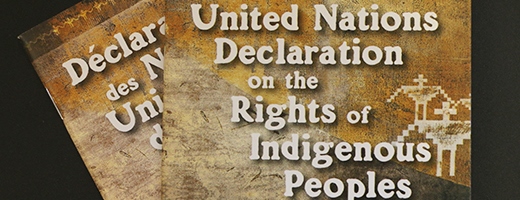
43. We call upon federal, provincial, territorial, and municipal governments to fully adopt and implement the United Nations Declaration on the Rights of Indigenous Peoples as the framework for reconciliation.
What's happening?
In 2016, the Government of Canada endorsed the UN Declaration on the Rights of Indigenous Peoples (UN Declaration) without qualification and committed to its full and effective implementation. This endorsement confirmed Canada’s commitment to a renewed, nation-to-nation, Inuit-Crown and government-to-government relationship with Indigenous Peoples – a relationship based on recognition of rights, respect, co-operation and partnership.
On June 21, 2021, the United Nations Declaration on the Rights of Indigenous Peoples Act (UN Declaration Act) received Royal Assent and immediately came into force. This legislation advances the implementation of the UN Declaration on the Rights of Indigenous Peoples as a key step in renewing the Government of Canada’s relationship with Indigenous Peoples.
The purpose of this Act is to affirm the UN Declaration as an international human rights instrument that can help interpret and apply Canadian law. It also provides a framework to advance implementation of the UN Declaration at the federal level.
This Act requires the Government of Canada, in consultation and cooperation with Indigenous Peoples, to:
- take all measures necessary to ensure federal laws are consistent with the UN Declaration
- prepare and implement an action plan to achieve the UN Declaration’s objectives
- table an annual report on progress to align the laws of Canada and on the action plan
Following the Royal Assent of the UN Declaration Act, Justice Canada launched a broad and inclusive consultation and cooperation process with Indigenous Peoples to support the development of the Action Plan, including the identification of measures to ensure consistency of federal laws with the UN Declaration. Following this extensive consultation and cooperation process with Indigenous partners, the UN Declaration Act Action Plan was released on June 21, 2023.
Recent Budget Investments
Budget 2021 provided $31.5 million over 2 years, starting in 2021 to 2022, to support the co-development of an Action Plan with Indigenous partners to implement the UN Declaration Act, including the development of the Action Plan.
Budget 2022 provided $37 million in funding over 5 years to support the core capacity of Indigenous governments, organizations, and groups to continue to contribute meaningfully to the implementation of the UN Declaration Act and the associated Action Plan.
Recent Progress
On June 21, 2023, the Government of Canada released the UN Declaration Act Action Plan. This evergreen Action Plan, which includes 181 measures to be led by over 25 federal departments and agencies, provides a roadmap of actions Canada will take with Indigenous Peoples to implement the rights and principles set out in the UN Declaration and to further advance reconciliation in a tangible way.
Funding announced in Budget 2022 to support the capacity of Indigenous partners to continue to meaningfully participate in the implementation of the UN Declaration Act, including the Action Plan, was allocated to Indigenous governments, representative organizations, and groups across the country, through the Indigenous Partnership Fund. Two funding streams support capacity building and UNDA-related activities. Funding through the Indigenous Partnership Fund has been fully allocated for the 2023 to 2024, 2024 to 2025, 2025 to 2026 and 2026 to 2027 fiscal years. In 2023 to 2024 and 2024 to 2025 the Indigenous Partnership Fund supported 126 Indigenous partners for a total of $20.5 million.
On March 20, 2025, the Minister of Justice and Attorney General of Canada announced the establishment of the United Nations Declaration on the Rights of Indigenous Peoples Act Action Plan Advisory Committee.
The committee is an Indigenous-led, independent body made up of 10 experts from diverse First Nations, Inuit, and Métis backgrounds and experiences, including Historic and Modern Treaty partners. The committee reflects distinct perspectives shaped by Indigenous cultures, languages, traditions, and experiences, including a gender-diverse range of Indigenous Peoples living in urban and rural areas.
The newly formed committee will provide valuable expertise and advice as the minister implements the Shared Priorities measures in the Action Plan, in consultation and cooperation with Indigenous Peoples and with other federal ministers.
The establishment of the committee is an important step in advancing implementation of measure 22 of the Shared Priorities chapter of the UN Declaration Act Action Plan.
On August 20, 2025, the Fourth Annual Progress Report on the implementation of the United Nations Declaration on the Rights of Indigenous Peoples Act was tabled in Parliament. The perspectives of 58 First Nations, Inuit and Métis rights holders and representative organizations, as well as reporting from 41 federal government departments and agencies form the foundation of this year's report.
Next Steps
The 181 measures in the United Nations Declaration on the Rights of Indigenous Peoples Act Action Plan outline the work that Canada will undertake with Indigenous Peoples over the next 5 years to advance the implementation of the UN Declaration. Over 25 federal departments and agencies will lead on specific measures falling under their respective mandates and will work closely with Indigenous partners on developing implementation plans, including timelines and metrics.
While the UN Declaration Act imposes obligations only on the federal government and the Action Plan is federal in scope, several Action Plan measures refer specifically to working with provinces and territories, along with Indigenous partners, while others would benefit from federal, provincial and territorial collaboration to advance implementation. Justice Canada and other departments leading on these measures will engage provincial and territorial partners to ensure successful implementation.
The UN Declaration Act also requires the federal government to work in consultation and cooperation with Indigenous Peoples to prepare an annual report on the progress of implementing the Action Plan and measures that ensure the federal laws are consistent with the UN Declaration.
Funding announced in Budget 2022 to support Indigenous capacity for sustained contributions to the UN Declaration Act and the Action Plan implementation continues to be provided through the Indigenous Partnership Fund for the 2024 to 2025 fiscal year. Funding through the Indigenous Partnership Fund will continue to be administered for the 2025 to 2026 and 2026 to 2027 fiscal years. As funding is ongoing, options for funding beyond March 31, 2027 will be proposed.
The committee will continue to meet over 2025 to 2026 and 2026 to 2027. Advice they may prepare is intended to complement, and not to replace, consultation and cooperation directly with First Nations, Inuit and Métis rightsholders and representative institutions, which will continue to be carried out through a range of mechanisms.
For more information on implementation of the United Nations Declaration on the Rights of Indigenous Peoples Act and the associated Action Plan, please refer to Call to Action 44.
44. We call upon the Government of Canada to develop a national action plan, strategies, and other concrete measures to achieve the goals of the United Nations Declaration on the Rights of Indigenous Peoples.
What's happening?
The United Nations Declaration on the Rights of Indigenous Peoples Act (the UN Declaration Act) requires the Government of Canada, in consultation and cooperation with Indigenous Peoples, to:
- take all measures necessary to ensure federal laws are consistent with the United Nations Declaration on the Rights of Indigenous Peoples (the UN Declaration)
- prepare and implement an action plan to achieve the UN Declaration’s objectives
- table an annual report on progress to align the laws of Canada and on the action plan
In this way, the UN Declaration Act responds to Calls to Action 43 and 44 at the federal level.
On June 21, 2023, the Government of Canada released the United Nations Declaration on the Rights of Indigenous Peoples Act Action Plan, in consultation and cooperation with First Nations Inuit and Métis.
The Action Plan contains 181 measures, put forward by First Nations, Inuit and Métis, that will guide steps needed to effectively implement the UN Declaration in Canada. It provides a roadmap of concrete actions Canada will take, in partnership with Indigenous Peoples, to implement the principles and rights set out in the UN Declaration and advance lasting reconciliation in a tangible way.
Justice Canada and lead federal departments and agencies will continue working with Indigenous partners to prioritize and sequence the implementation of the 181 measures in the Action Plan. The implementation of these measures will contribute to achieving the objectives of the UN Declaration and advancing transformative change. Justice Canada will also work to ensure transparent and accountable reporting on progress.
Background and Current Status
Following the Royal Assent of the UN Declaration on the Rights of Indigenous Peoples Act, Justice Canada launched a broad and inclusive consultation and cooperation process to support the development of an action plan, the identification of measures to ensure consistency of federal laws with the UN Declaration and the development of annual reports on progress. Following the is extensive consultation and cooperation process with Indigenous partners, the UN Declaration Act Action Plan was released on June 21, 2023.
Recent Budget Investments
Budget 2021 provided $31.5 million over 2 years, starting in 2021 to 2022, to support the co-development of an Action Plan with Indigenous partners to implement this legislation UN Declaration Act and to achieve the objectives of the UN Declaration.
Budget 2022 provided $37 million in funding over 5 years to support the core capacity of Indigenous governments, organizations, and groups to continue to contribute meaningfully to the implementation of the UN Declaration Act and the associated Action Plan.
Recent Progress
In December 2021, Justice Canada launched a two-phased broad, inclusive and distinctions-based consultation and cooperation process with Indigenous Peoples to better understand their priorities in order to shape the Action Plan and to begin to identify potential measures for aligning federal laws with the UN Declaration. As a result of this in-depth consultation and cooperation process, over 300 bilateral meetings, thematic sessions and roundtables were held, and over 120 written submissions proposing more than 3000 Action Plan measures were received.
On June 21, 2023, the Government of Canada released the UN Declaration Act Action Plan. This evergreen Action Plan, which includes 181 measures to be led by over 25 federal departments and agencies, provides a roadmap of actions Canada will take with Indigenous Peoples to implement the rights and principles set out in the UN Declaration and to further advance reconciliation in a tangible way.
Preparation of the 2023 Annual Progress Report prioritized expanding consultation with Indigenous partners in the development of its content. Seventeen Indigenous partners contributed to the report, as well as 36 government departments and agencies. In addition, 33 Indigenous partners informed the development of the annual reporting process more broadly by contributing more than 200 specific suggestions related to Section 7 of the UN Declaration Act.
Funding announced in Budget 2022 to support Indigenous capacity for sustained contributions to the UN Declaration Act and the Action Plan implementation will be equitably allocated to Indigenous governments, organizations, and groups, through the Indigenous Partnership Fund. Funding through the Indigenous Partnership Fund has been fully allocated for the 2023 to 2024, 2024 to 2025, 2025 to 2026 and 2026 to 2027 fiscal years. In 2023 to 2024 and 2024 to 2025 the Indigenous Partnership Fund supported 126 Indigenous partners for a total of $20.5 million.
On March 20, 2025, the Minister of Justice and Attorney General of Canada announced the establishment of the United Nations Declaration on the Rights of Indigenous Peoples Act (UN Declaration Act) Action Plan Advisory Committee.
The committee is an Indigenous-led, independent body made up of 10 experts from diverse First Nations, Inuit, and Métis backgrounds and experiences, including Historic and Modern Treaty partners. The committee reflects distinct perspectives shaped by Indigenous cultures, languages, traditions, and experiences, including gender-diverse Indigenous Peoples living in urban and rural areas.
The newly formed committee will provide valuable expertise and advice as the minister implements the Shared Priorities measures in the Action Plan, in consultation and cooperation with Indigenous Peoples and with other federal ministers.
The establishment of the committee is an important step in advancing implementation of measure 22 of the Shared Priorities chapter of the UN Declaration Act Action Plan.
On August 20, 2025, the Fourth Annual Progress Report on the implementation of the United Nations Declaration on the Rights of Indigenous Peoples Act was tabled in Parliament. The perspectives of 58 First Nations, Inuit and Métis rights holders and representative organizations, as well as reporting from 41 federal government departments and agencies form the foundation of this year's report.
Next Steps
The 181 measures in the UN Declaration Act Action Plan outline the work that Canada will undertake with Indigenous Peoples over the next 5 years to advance implementation of the UN Declaration. Over 25 federal departments and agencies will lead on specific measures following under their respective mandates and will work closely with Indigenous partners on developing implementation plans, including timelines and metrics.
While the UN Declaration Act imposes obligations only on the federal government and the Action Plan is federal in scope, several Action Plan measures refer specifically to working with provinces and territories, along with Indigenous partners, while others would benefit from FPT collaboration to advance implementation. Justice Canada and other departments leading on these measures will engage provincial and territorial partners to ensure successful implementation.
The UN Declaration Act also requires federal government, in consultation and cooperation with Indigenous Peoples, to prepare an annual report on progress made toward implementation of the Action Plan and on measures to ensure the consistency of federal laws with the UN Declaration.
Funding announced in Budget 2022 to support Indigenous capacity for sustained contributions to the UN Declaration Act and the Action Plan implementation continues to be administered through the Indigenous Partnership Fund for the 2024 to 2025 fiscal year. Funding through the Indigenous Partnership Fund to support core capacity will continue to be administered for the 2025 to 2026 and 2026 to 2027 fiscal years. As funding is ongoing, options for funding beyond March 31, 2027 will be proposed.
The committee will continue to meet over 2025 to 2026 and 2026 to 2027. Advice they may prepare is intended to complement, and not to replace, consultation and cooperation directly with First Nations, Inuit and Métis rightsholders and representative institutions, which will continue to be carried out through a range of mechanisms.
For more information on implementation of the United Nations Declaration on the Rights of Indigenous Peoples Act and the associated Action Plan, please refer to Call to Action 43.