Royal Proclamation and Covenant of Reconciliation
Learn how the Government of Canada is responding to the Truth and Reconciliation Commission's Calls to Action 45 to 47.
- Based on data provided October 2025
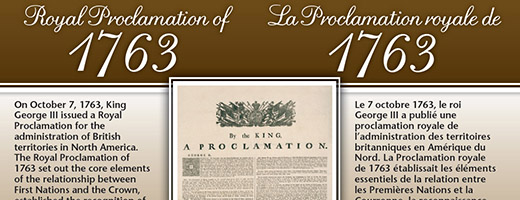
45. We call upon the Government of Canada, on behalf of all Canadians, to jointly develop with Aboriginal peoples a Royal Proclamation of Reconciliation to be issued by the Crown. The proclamation would build on the Royal Proclamation of 1763 and the Treaty of Niagara of 1764, and reaffirm the nation-to-nation relationship between Aboriginal peoples and the Crown. The proclamation would include, but not be limited to, the following commitments:
- Repudiate concepts used to justify European sovereignty over Indigenous lands and peoples such as the Doctrine of Discovery and terra nullius.
- Adopt and implement the United Nations Declaration on the Rights of Indigenous Peoples as the framework for reconciliation.
- Renew or establish Treaty relationships based on principles of mutual recognition, mutual respect, and shared responsibility for maintaining those relationships into the future.
- Reconcile Aboriginal and Crown constitutional and legal orders to ensure that Aboriginal peoples are full partners in Confederation, including the recognition and integration of Indigenous laws and legal traditions in negotiation and implementation processes involving Treaties, land claims, and other constructive agreements.
What's happening?
The Government of Canada continues to pursue the objectives of Call to Action 45 by renewing the relationship with Indigenous peoples based on the recognition and implementation of rights, respect, cooperation and partnership.
This approach aligns with the United Nations Declaration on the Rights of Indigenous Peoples and advances self-determination.
Since 2015, the Government of Canada has:
- endorsed the declaration and enshrined it in Canadian law through the passage of the United Nations Declaration on the Rights of Indigenous Peoples Act in 2021
- worked in consultation and cooperation with First Nations, Inuit and Métis to develop an action plan to achieve the objectives of the UN Declaration
- released the co-developed Inuit Nunangat Policy, which guides federal departments and agencies in the design, development and delivery of initiatives that apply in Inuit Nunangat
- adopted the Cabinet Directive on the Federal Approach to Modern Treaty Implementation and the Cabinet Directive on the Implementation of the Inuit Nunangat Policy
- adopted and released the Principles Respecting the Government of Canada's Relationship with Indigenous Peoples
- adopted new strategies to pursue negotiation rather than litigation as the preferred path to resolve disputes, including the release of the Attorney General of Canada’s Directive on Civil Litigation Involving Indigenous Peoples
- worked with First Nations, Inuit and Métis to co-develop and advance shared priorities
- worked with Indigenous partners to explore new ways to advance the recognition of Indigenous rights and self-determination
Recent budget investments
Budget 2021 proposed to provide $31.5 million over 2 years to support the co-development of an Action Plan with Indigenous partners to implement the United Nations Declaration on the Rights of Indigenous Peoples Act and to achieve the objectives of the Declaration.
To advance rights-based discussions, Budget 2024 proposed to provide $96.4 million over 2 years to Crown-Indigenous Relations and Northern Affairs Canada to ensure that Indigenous communities can fully participate in the negotiation process.
Recent progress
Adoption and implementation of UNDRIP
The United Nations Declaration on the Rights of Indigenous Peoples Act received Royal Assent on June 21, 2021. The act provides a roadmap for the federal government and Indigenous peoples to work together to implement the United Nations Declaration on the Rights of Indigenous Peoples in Canada.
The act repudiates concepts used to justify European sovereignty over Indigenous lands and peoples such as the Doctrine of Discovery and Terra Nullius.
In 2023, following 2 years of working in consultation and cooperation with First Nations, Inuit and Métis from across Canada, the Government of Canada published an Action Plan to achieve the objectives of the UN Declaration, and to identify measures needed to ensure federal laws are consistent with the UN Declaration. This Action Plan provides a roadmap of actions Canada needs to take in partnership with Indigenous peoples to implement the principles and rights set out in the UN Declaration and to further advance reconciliation in a tangible way.
Implementation of the UN Declaration and the Action Plan continues.
Renewing or establishing treaty relationships
In 2022, the Government of Canada released the Inuit Nunangat Policy, which guides federal departments and agencies in the design, development and delivery of all new or renewed federal policies, programs, services, and initiatives that apply in Inuit Nunangat and/or benefit Inuit, including programs of general application, and to support Inuit self-determination.
In 2023, after co-development with First Nations, Inuit and Métis Modern Treaty partners, the Government of Canada released Canada’s Collaborative Modern Treaty Implementation Policy. The policy supports the full, effective, and timely implementation of all current and future modern treaties in Canada, with the specific goal of advancing a systemic shift in institutional culture. The policy’s key principles will guide federal officials in upholding the spirit and intent of modern treaties and includes requirements that legislative, policy, and program design take into account and reflect the unique circumstances of each modern treaty partner. This represents a significant milestone that will support the transformation of Indigenous–Crown intergovernmental relationships to ensure that Canada is fulfilling its obligations as a treaty partner, while also implementing the aims and objectives of the UN Declaration.
In 2025, the Government of Canada published the Cabinet Directive on the Implementation of the Inuit Nunangat Policy. The Cabinet Directive provides an operational framework supporting the consistent implementation of the Inuit Nunangat Policy across federal departments and agencies, guides federal departments and agencies to fulfill their responsibilities, and enables whole-of-government monitoring and evaluation of implementation.
In 2025, the Government of Canada also introduced Bill C-10, An Act respecting the Commissioner for Modern Treaty Implementation, which proposes to create an independent, credible, effective, and sustainable oversight mechanism to hold the government accountable to Parliament for its implementation of modern treaties, consistent with commitments in the Collaborative Modern Treaty Implementation Policy.
Recognition and integration of Indigenous laws and legal traditions in negotiation and implementation processes
In 2022, members of the Inuit-Crown Partnership Committee endorsed the Inuit-Crown Co-Development Principles, which are intended to be implemented and applied by Inuit and all federal partners engaged in co-development initiatives. The principles are premised on respect and support for Inuit rights to self-determination and participation in decision-making affecting Inuit.
In 2024, leadership from across the Métis Nation and the federal government unanimously agreed to co-development principles – a set of guiding principles that will determine how Canada and the Métis Nation will work together going forward. The agreed upon principles express a mutual desire between the Métis Nation and Canada to work together equitably, through their distinct decision-making processes that are considered of equal validity and weight, to deliver the best results for Métis.
Next steps
The Government of Canada continues to explore ways to address Call to Action 45, in collaboration with Indigenous peoples.
46. We call upon the parties to the Indian Residential Schools Settlement Agreement to develop and sign a Covenant of Reconciliation that would identify principles for working collaboratively to advance reconciliation in Canadian society, and that would include, but not be limited to:
- Reaffirmation of the parties' commitment to reconciliation.
- Repudiation of concepts used to justify European sovereignty over Indigenous lands and peoples, such as the Doctrine of Discovery and terra nullius, and the reformation of laws, governance structures, and policies within their respective institutions that continue to rely on such concepts.
- Full adoption and implementation of the United Nations Declaration on the Rights of Indigenous Peoples as the framework for reconciliation.
- Support for the renewal or establishment of treaty relationships based on principles of mutual recognition, mutual respect, and shared responsibility for maintaining those relationships into the future.
- Enabling those excluded from the Settlement Agreement to sign onto the Covenant of Reconciliation.
- Enabling additional parties to sign onto the Covenant of Reconciliation.
What's happening?
The Government of Canada is working with representatives from the Indian Residential Schools Settlement Agreement All Parties Table (IRSSA All Parties Table) to advance the development and implementation of the Covenant of Reconciliation. The IRSSA All Parties Table is made up of signatories to the IRSSA. It includes representatives from the Assembly of First Nations, Inuit Tapiriit Kanatami, Anglican Church of Canada, Jesuits of Canada, Our Lady of Guadalupe Circle, Presbyterian Church of Canada, and United Church of Canada and Crown-Indigenous Relations and Northern Affairs Canada (CIRNAC).
The IRSSA All Parties Table has finalized a Draft Covenant of Reconciliation which identifies principles for working collaboratively to advance reconciliation. This includes appropriate spiritual language to reflect Indigenous experiences. Representatives from the Assembly of First Nations, Inuit Tapiriit Kanatami, and Justice Canada formed a legal review committee to review legal considerations of the Draft Covenant of Reconciliation.
Recent progress
- The IRSSA All Parties Table has shared the Draft Covenant of Reconciliation within their organization and members are seeking input within their own internal structures.
- CIRNAC is the lead on engagement with those that may have an interest in adopting Call to Action 46 that were not signatories to the Settlement Agreement. CIRNAC, supported by Justice Canada, has conducted technical briefings with interested entities on the Draft Covenant as a preliminary step in the engagement process.
Next steps
- There is an ongoing commitment to move forward with discussions on how to implement the Covenant and take concrete actions to advance reconciliation.
47. We call upon federal, provincial, territorial, and municipal governments to repudiate concepts used to justify European sovereignty over Indigenous peoples and lands, such as the Doctrine of Discovery and terra nullius, and to reform those laws, government policies, and litigation strategies that continue to rely on such concepts.
What's happening?
This call to action is currently being addressed in Calls to Action 45 and 46, which includes specific language on the Doctrine of Discovery and Terra Nullius. At this stage, focus remains largely on advancing work on Call to Action 46.
In addition, the preamble to the United Nations Declaration on the Rights of Indigenous Peoples Act, which came into force on June 21, 2021, rejects all forms of colonialism and notes that doctrines, policies and practices based on or advocating the superiority of peoples or individuals on the basis of national origin or racial, religious, ethnic or cultural differences, including the doctrines of discovery and terra nullius, are racist, scientifically false, legally invalid, morally condemnable and socially unjust.